

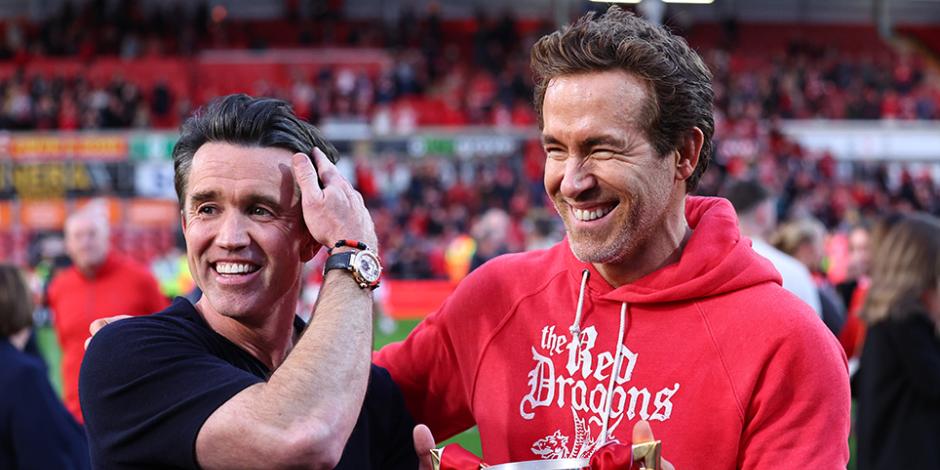
In the small town of Wrexham, in the north-eastern corner of Wales, a few thousand people are watching a football match. That’s not unusual, but there’s a different buzz (ifml.)Aufregung, Begeisterungbuzz about this game. Some of the spectatorZuschauer(in)spectators have come from as far away as Canada and Australia. That’s because the local football club here, Wrexham AFC (Association Football Club), is owned by Hollywood celebrities Ryan Reynolds and Rob McElhenney, and it’s the subjecthier: Themasubject of the hit documentary series Welcome to Wrexham.
With the FIFA World Cup, football is coming to North America in 2026 but, in Britain, Americans have been coming to football. More than half of the 92 clubs in the four professional English leagueLigaleagues (which include some Welsh clubs) have at least some American ownershiphier: Anteilbesitzownership — including big names such as Manchester United, Liverpool and Chelsea.
Foreign ownership isn’t new in English football, but investors from the US seem to have flood inhereinströmenflooded in recently. Kevin Nagle, the American owner of the Yorkshire-based club Huddersfield Town, told NPR: “I guess, instead of saying ‘the British are coming’, we say ‘the Americans are coming’.”
More kick per dollar
To fans, football often looks like big business, but that needs to be put sth. into perspectiveetw. ins rechte Licht rückenput into perspective. The world’s richest club, Real Madrid, earned almost €1.2 billionMilliarde(n)billion in revenueEinnahme(n)revenue in the 2024–25 season. In the world of sport, Real Madrid is a whaleWal(fisch)whale. In business, however, it’s a rather small, ifhier: wenn auchif highly recognizablemit hohem Wiedererkennungswerthighly recognizable, fish. A look at Fortune 500 Europe shows that the Swiss insurance provider Bâloise Group, the 500th largest European company (by revenue), generates almost $7 billion a year.
For Americans, an investment in English football looks cheap, compared with the big US sports franchises, such as the NFL or the NBA. Premier League games are followed by billions of people and broadcast sth.etw. übertragen, sendenbroadcast to more than 200 countries and territories around the world, and that’s an attractive prospectAussicht, Perspektiveprospect for a US multinational that sells to customers in Asia, for example.
In many cases, the return on investment (ROI)Investmentrenditereturn on investment has been excellent. Reynolds, a Canadian who became a US citizen in 2018, and McElhenney bought Wrexham for just £1 in 2021 — the club was in a diremiserabel, katastrophaldire financial situation at the time. The pair immediately invested £2 million and have turned things around, both on the pitch (UK)hier: Spielfeldpitch and on the balance sheetBilanzbalance sheet. Today, the club is valued as high as £500 million. While Wrexham is an extreme example, it’s not the only one. Fenway Sports Group bought a controlling shareAnteilshare of Liverpool in 2010, for £300 million. Today, the club is valued at more than £4 billion.
Investors expect to see a financial returnFinanzrenditefinancial return, of course, but they’re also human, and owning a football club is fun. Giving away tickets to games is a good way to impress people or reward loyal employees. And owning a club in Britain, the country with the longest football heritageErbe, Traditionheritage, is prestigious. “It’s just amazing when we see a lot of our fans, because their greathier: Ur-great, great, great-grandparents were watching the team play,” Nagle says. “Do we love our soccer (US)Fußballsoccer in the US? Yes. But do we have the traditions [of] the UK? Absolutely not.”
Neugierig auf mehr?
Dann nutzen Sie die Möglichkeit und stellen Sie sich Ihr optimales Abo ganz nach Ihren Wünschen zusammen.